


The Mathematics III Lesson Study Group of Santa Lucia High School which was composed of four mathematics teachers and one UP NISMED facilitator highlighted multiple solutions in their research lesson on Geometric Relations. The lesson was about the Parallel Postulate which was an offshoot of the problem shown below. In the problem, if a horizontal diagonal is drawn, the diagonal and the line segment containing the base are parallel and the two sides that connect the parallel segments are transversals. This leads to the concept that corresponding angles are congruent which is known as the Parallel Postulate.

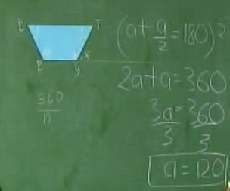

During lesson planning, the teachers and the facilitator came up with 11 anticipated solutions. Questions were formulated on how to process the solutions. Follow up questions were listed in case students could not answer the questions. The key questions and the expected answers were emphasized in the lesson plan.
The lesson was implemented for two days in four sections. Most of the students used previous knowledge in solving the problem, but there were some who came up with intuitive solutions. Some solutions presented were not even anticipated by the teachers and the UP NISMED facilitator.
After each lesson implementation, the facilitator and the teachers met to discuss what went well, what went wrong, and the strategies to be used to improve the lesson.
The teachers were pleased with the result of the thorough planning. They were able to anticipate students’ answers and were able to address misconceptions. They also observed that students were more participative and active in class discussions.
By Guillermo Bautista Jr.
By Guillermo Bautista Jr.


